
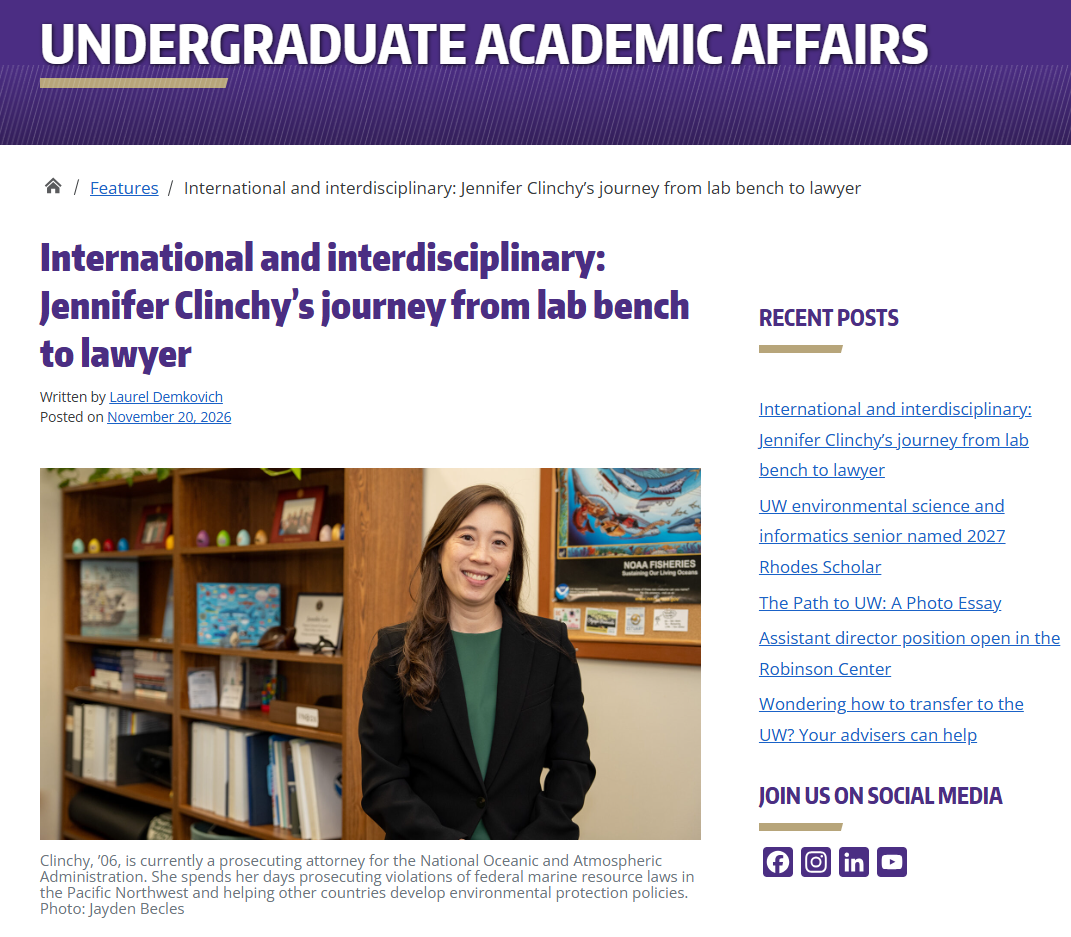
When I entered college, I wanted to be a turtle biologist. As it turned out, though, my academic prowess did not translate into success in the lab. My chemistry experiments frequently caught fire. I struggled to mentally rotate molecules in three dimensions. But most importantly, I found that I craved a more tangible impact from my work.
I constantly pressed my lab’s Principal Investigator on the impact our research would have for society. I’m sure it must have become annoying as I kept asking, “But why does this research matter? How will it make a difference for the world?”
Thanks to the University of Washington (UW), I received multiple fellowships as a college student that enabled me to practice being a research scientist before I had to commit to a Ph.D. program. Discovering that hands-on lab research was not for me was crucial in illuminating the career path that was.
Last Friday, UW published an article about my journey from the lab bench to law. What became clear was how my early research science experiences spurred my pivot into science policy and law. As the article shares, there is no wrong path you can go down in your career. I have met so many happy professionals with nonlinear career paths. Sometimes, the serendipitous evolutions in our careers are the ones that bring us closer to the work that matters most.
If there is a formative experience or form of support you received along your own career journey, think about how you might pay it forward. Not all support requires philanthropy; I fully recognize that not everyone is in a position to give. Other ways in which you can support students include accepting their requests for a coffee chat, inviting them to shadow you for a day, and recommending resources or connections that might help them learn more about a career before they fully commit to it.
Another way to support students is to volunteer as a mentor or speaker in programs like Hack Your Summer, which my inspiring colleague DJ Patil launched earlier this year. Together, we can all support young professionals and their growth.
How early career explorations can illuminate your path
Next
Next