
Five tips for better resume writing
Resume writing is a strategic endeavor. A recruiter may spend only ten seconds scanning your resume to determine if you warrant further evaluation. Word choice, word order, and conciseness all matter. Here are five tips to write a resume that compels a recruiter to stop scanning and start reading.
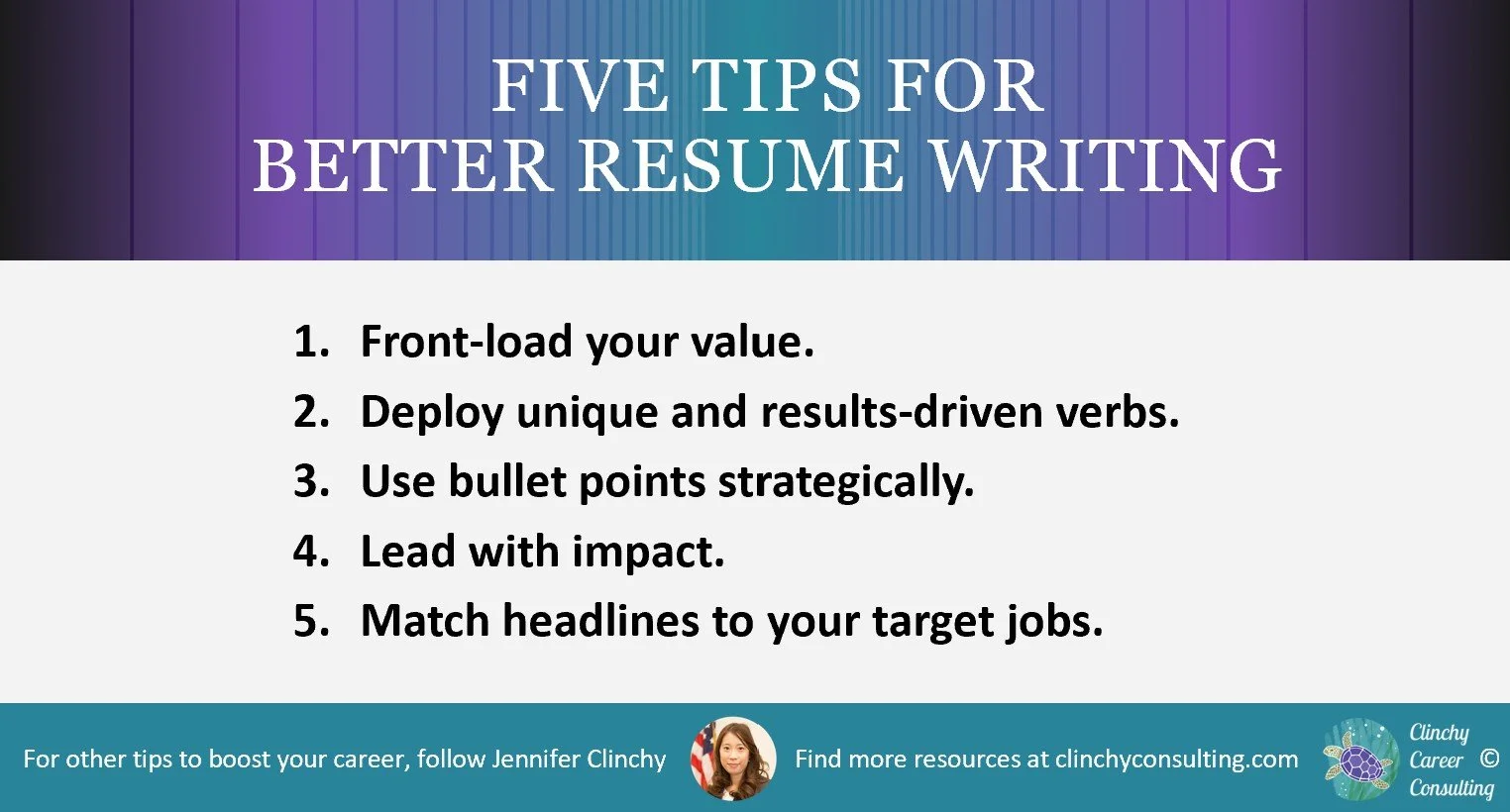
Front-load your value. The first five words in each bullet point must explain why your work mattered. What did you accomplish? How did it make a difference? How did your work enable your employer to more efficiently and effectively achieve its mission? When your resume answers these questions, the reader understands how you delivered value and how you can contribute to them now.
Deploy unique and results-driven verbs. Every bullet point should start with a vivid action verb. Don’t use the same verb twice on the same page. Yes, really! Variety in your vocabulary increases engagement and reduces reader boredom. Rather than say you “developed” something, be specific. Did you “create” it? Perhaps you “launched” or “designed” or “deployed” it. All of these words are stronger choices than “developed.” The thesaurus is your friend; consult it.
Use bullet points strategically. In your Experience section, use bullet points, rather than mini paragraphs or one long-winded sentence. Limit each bullet point to 1-2 lines. Bullet points are easier than mini paragraphs to quickly scan. Shorter sentences within a single bullet point are better than longer ones. If you can’t read the bullet point out loud without catching your breath, shorten it or break it into two sentences within a single bullet point.
Lead with impact. Sequence your bullet points by impact, not by chronology. Your most impressive accomplishment should appear first in the list, even if it was not the most recent achievement. To tailor your resume to specific job applications, you may shuffle the order of your bullet points so that the most relevant points appear first.
Match headlines to target jobs. Use a descriptive headline that explains who you are as a professional. Ideally, your headline matches the job title of your target position. When a recruiter sees your headline and confirms that you’re exactly the type of professional they need to hire, they read on. Tailor your headline for each job application to maximize being a match every time you apply.